

Overview
Updated 3 October 2026 · applies to 1.0.0 · Commercial
Memcached is a cache, and BROKA operates it as one. There are no queues, no topics, no offsets and no delivery — so this section has five screens rather than a broker's dozen, and the first question they answer is the one a cache actually raises: why is it evicting?
A connection is a list of servers, not a cluster
This is the fact everything else follows from. Memcached servers share no state and no view of each other. They are started separately, they are reached separately, and nothing on one of them knows that any of the others exist — there is no discovery, so the console knows only the addresses you configured on the connection.
Two consequences you will meet immediately:
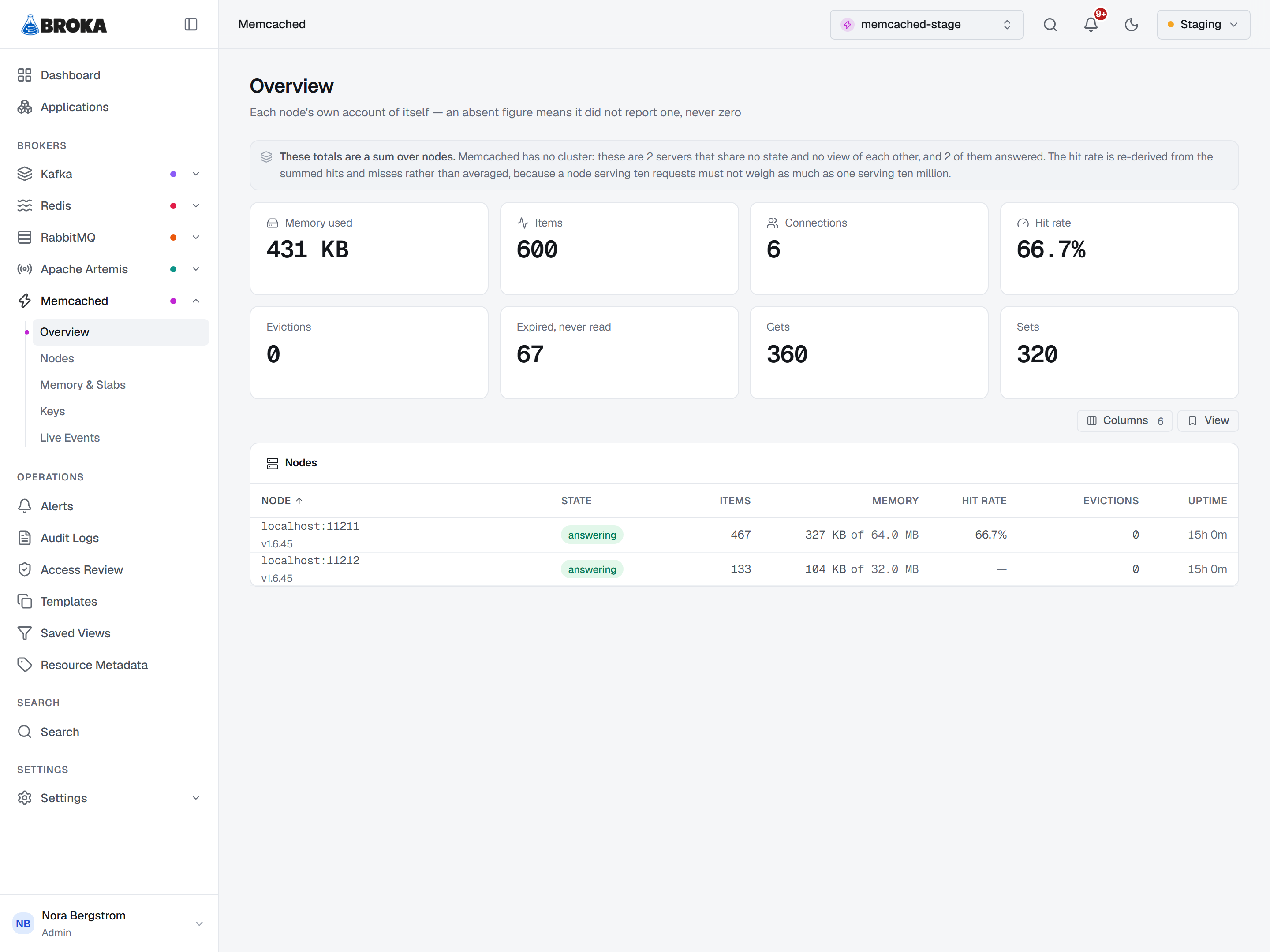
- The totals on this page are a sum over nodes, not a cluster's figures. Adding item counts gives the number of items in the estate, which is useful. Averaging hit rates would give a number with no referent, so the hit rate is re-derived from the summed hits and misses — a node serving ten requests must not weigh as much as one serving ten million.
- Two nodes of one connection genuinely differ in what they can do. Each capability is a start-up
flag, so a node launched with
-Xwill not list its keys while its neighbour will. That is normal configuration, not a fault, and every screen shows it per node.
An absent figure is not a zero
Which counters a node reports varies by version and by build. Every figure on this page renders — when the node did not report one.
The difference matters most exactly where it is easiest to lose. A 0 in an eviction tile is a
measurement: this node has discarded nothing. Being told nothing is not a measurement, and drawing it
as 0 would be a claim you have no way to check.
What the tiles say
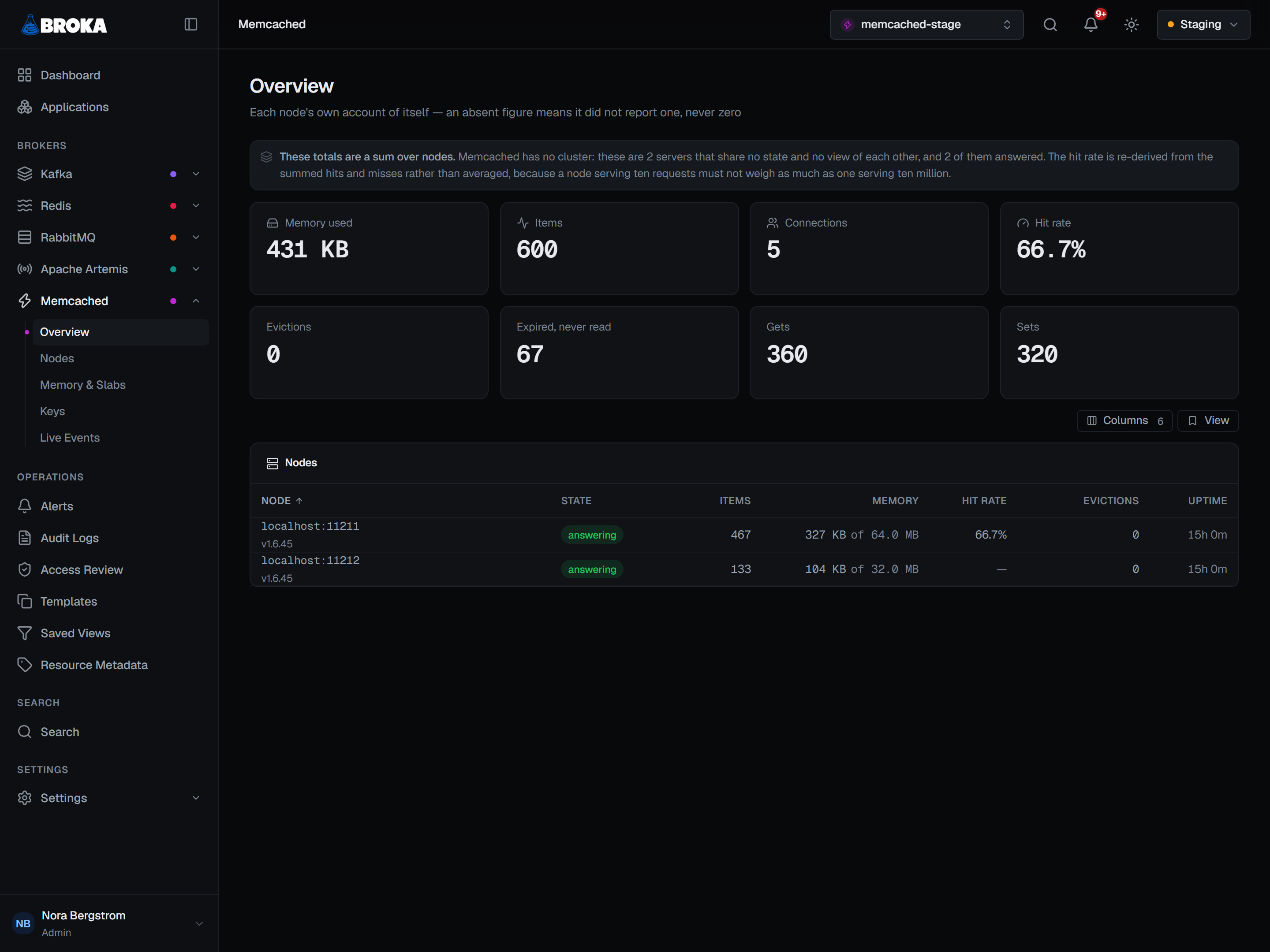
The first row is the estate: memory used, items, connections and the hit rate. The second row is the four counters that answer why a cache is behaving as it is — evictions, expired but never read, gets and sets.
Expired, never read is the one worth pausing on. It counts items that reached their expiry without anybody ever asking for them, and a large number beside a small hit rate usually means things are being cached that nothing consumes.
The node table
One row per configured address, with the version it reports and whether it answered at all. A node that did not answer says did not answer and carries the reason it gave, rather than being drawn as a node holding nothing.
Every node is asked at once, and the page has its answer within fifteen seconds whatever the nodes do. A node still silent by then — restarting, or behind a firewall that drops rather than refuses — says did not answer, with the reason The node did not answer within 15 seconds., and the others are shown as they answered; before, a few such nodes kept the whole page waiting until it failed. The Memory and slabs and Nodes pages read their nodes the same way.
Columns chooses which of the columns below are shown and View saves that layout. Connections is hidden until you turn it on there.
| Column | What it is |
|---|---|
| Items · Memory | This node's own counts. Memory shows what is held against the ceiling the node was given. |
| Hit rate | Absent until something has been read — a cache nobody has queried has no ratio to take, and 0% would read as a cache that never hits. |
| Evictions | Items discarded to make room, with the rate since this node started. Memcached keeps no history, so a shorter window would have to be invented. |
| Connections | Open sockets against the ceiling, with how many more before the node starts refusing. The ceiling is a start-up setting; a node that did not report it has no headroom to state. |
| Uptime | How long this node has been running — which is also the window every rate above is averaged over. |
A node older than 1.6.45
BROKA is built against 1.6.45 and says so when a node is older. It is not a refusal: the node is read normally. Behaviour and the available protocol flags differ materially across 1.6.x, so a feature that turns out to be missing on that node has its explanation at the top of the screen rather than looking like a fault.
Where to go next
- A node is evicting, or memory does not add up → Memory and slabs. This is the screen the platform is worth having, and it is where "half full but still evicting" becomes visible.
- What can this node actually do → Nodes, which also owns the four changes that act on a server.
- One key → Keys. There is no key browser by default, and the reason is on Listing keys.
- What is happening right now → Live events.
Memcached ships in Commercial. What an operator may do with it is decided by their permissions and by the environment's guard policy, which are separate questions from the edition.