

What changed in BROKA from 1.0 to 1.1
BROKA 1.0.0 was released on 5 October 2026, and 1.1.2 on 8 October. This is what the four releases in between added, in one place — the release notes have every line.
The short version: Kafka now reports its own health over JMX, alert rules reach the components around Kafka, the Commercial edition gained an MCP server and data masking, and every installation can tell you when a newer release is out. The rest is the work that makes those dependable.
Kafka's own health, over JMX (1.0.1)
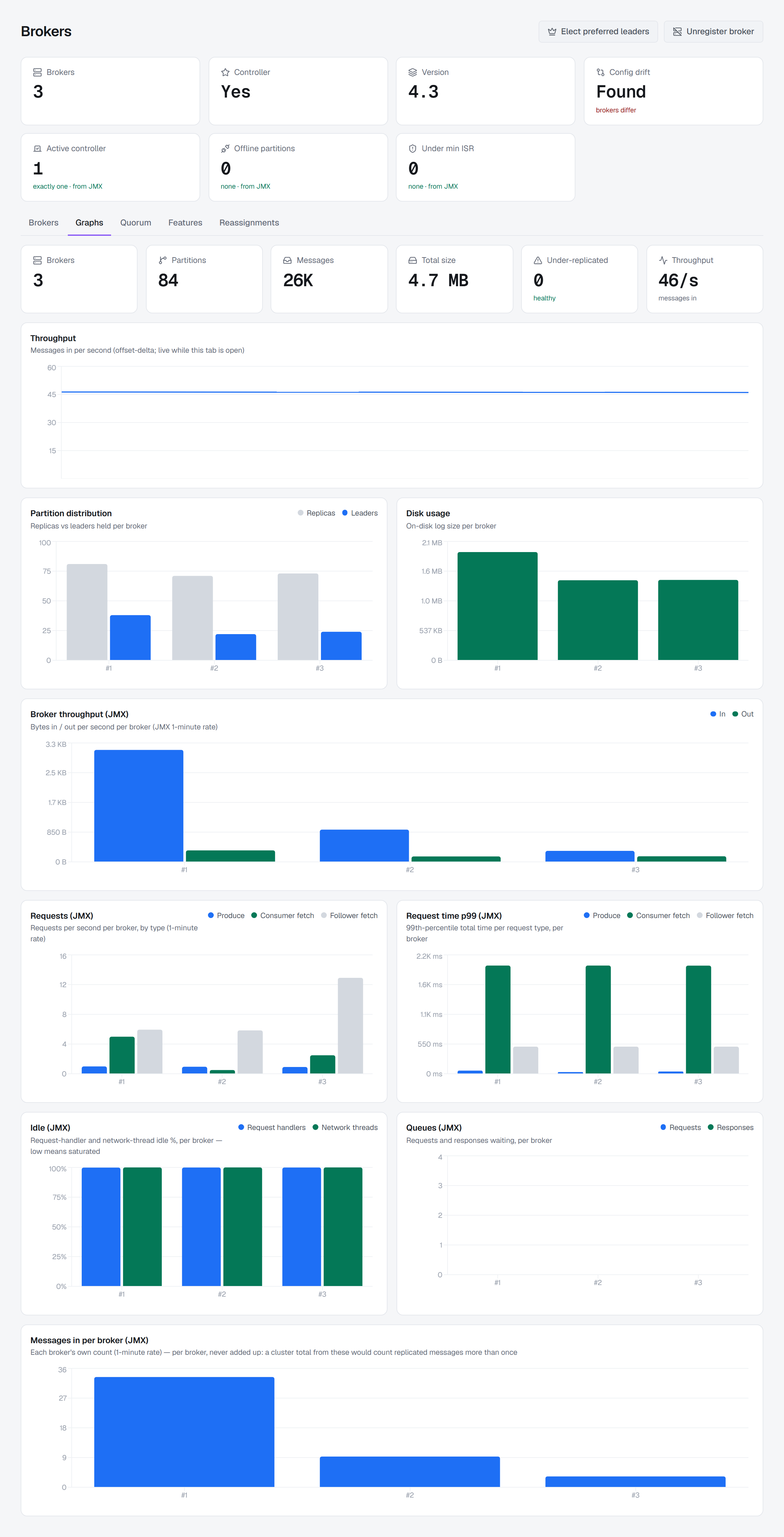
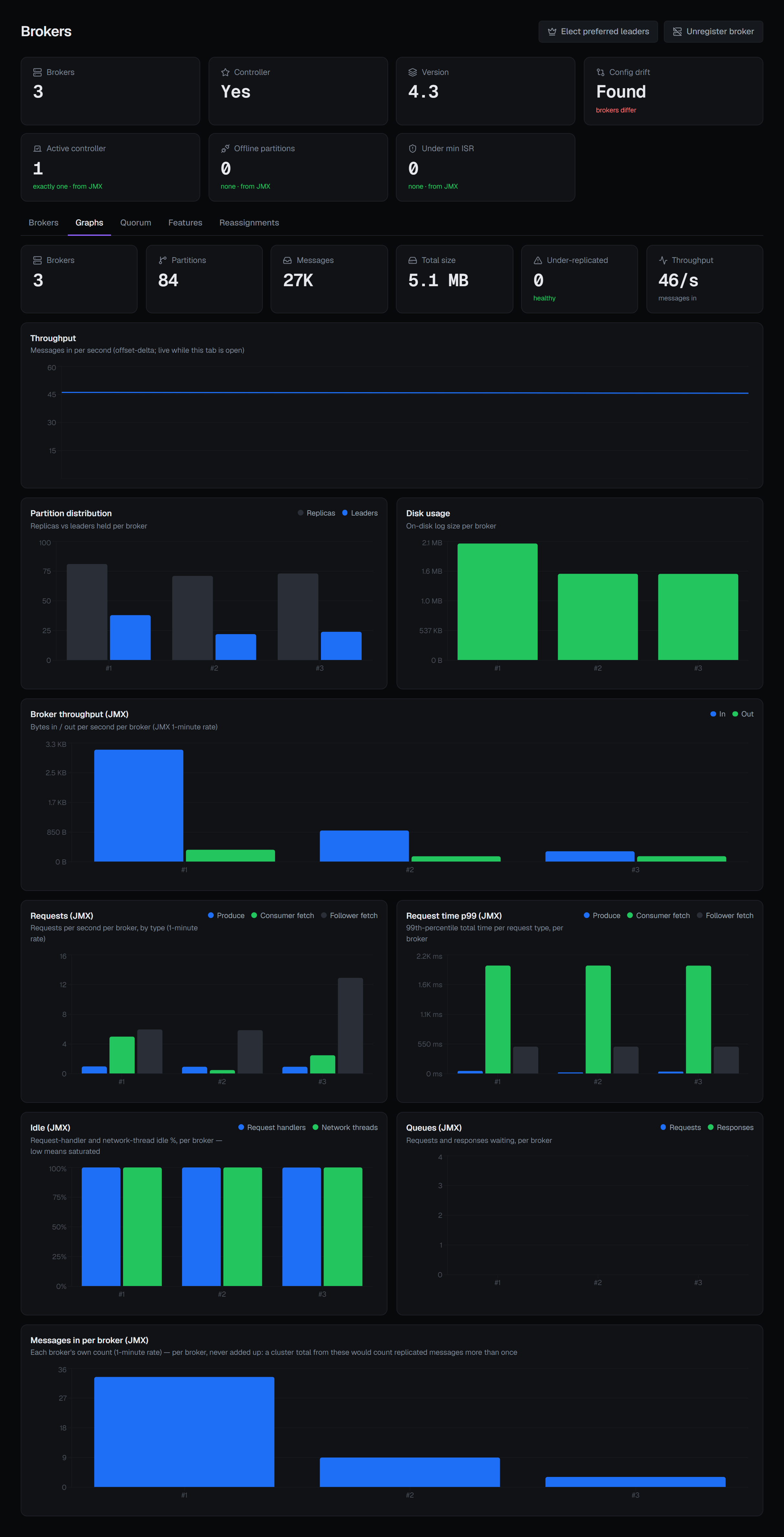
With JMX set up, every broker and controller reports what it measures about itself — the active controller, offline partitions, partitions under their minimum in-sync replicas, request rates and their 99th-percentile time, how idle the request handlers and network threads are, heap, garbage collection, CPU and file descriptors. The figures are read live and never stored.
- Health on the Brokers page — Active controller, Offline partitions and Under min ISR tiles.
- Graphs — requests per second and their p99 time by type, handler and network idle, the request and response queues, and messages in per broker.
- A broker's Metrics tab — heap, garbage collection, CPU, file descriptors, threads and log flush time. A controller that is not a broker is read as a node too.
- JMX in its own dialog — an address per broker and per controller, and a test that asks every node once and names why one did not answer.
Alerts on what surrounds Kafka (1.0.1)
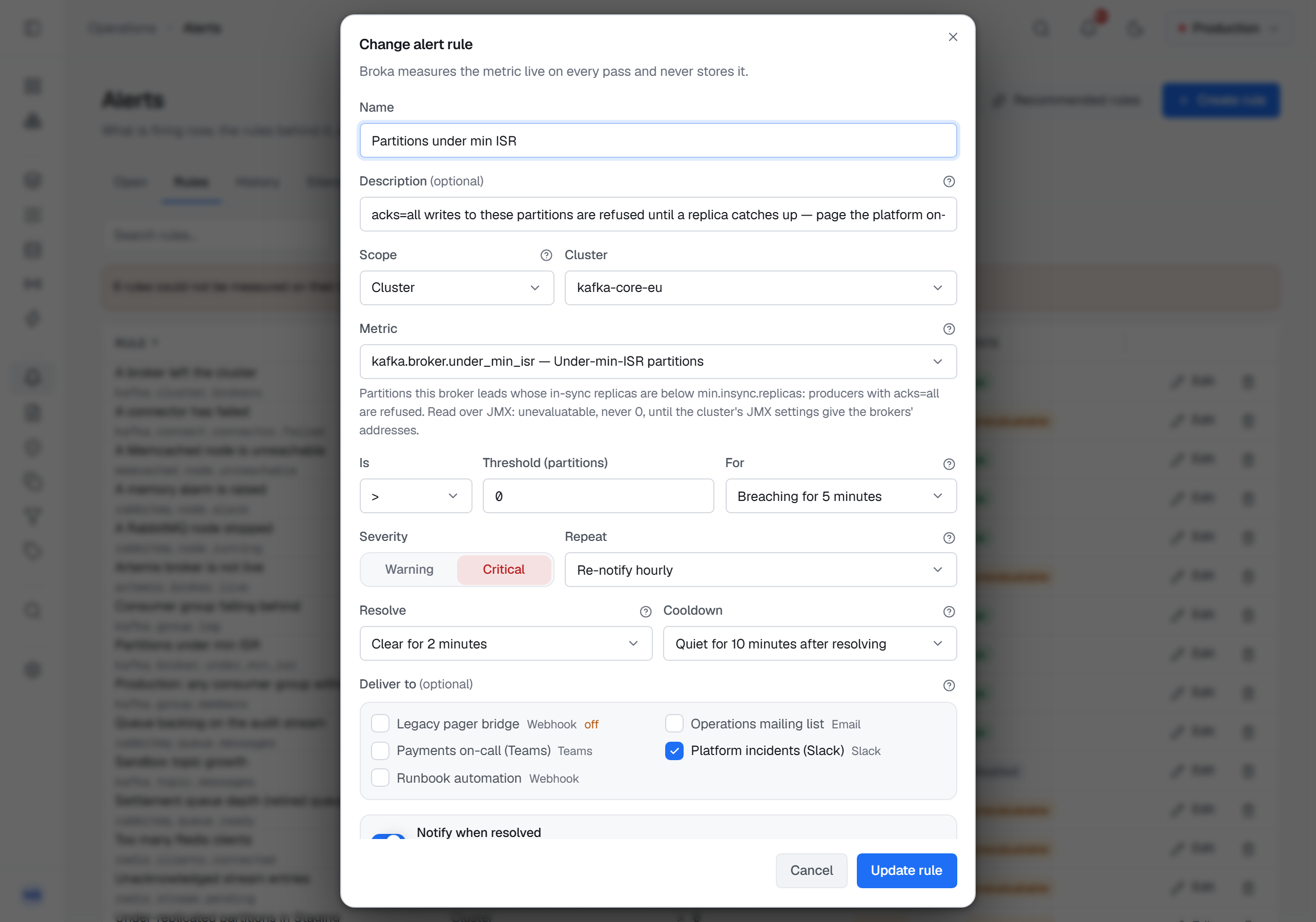
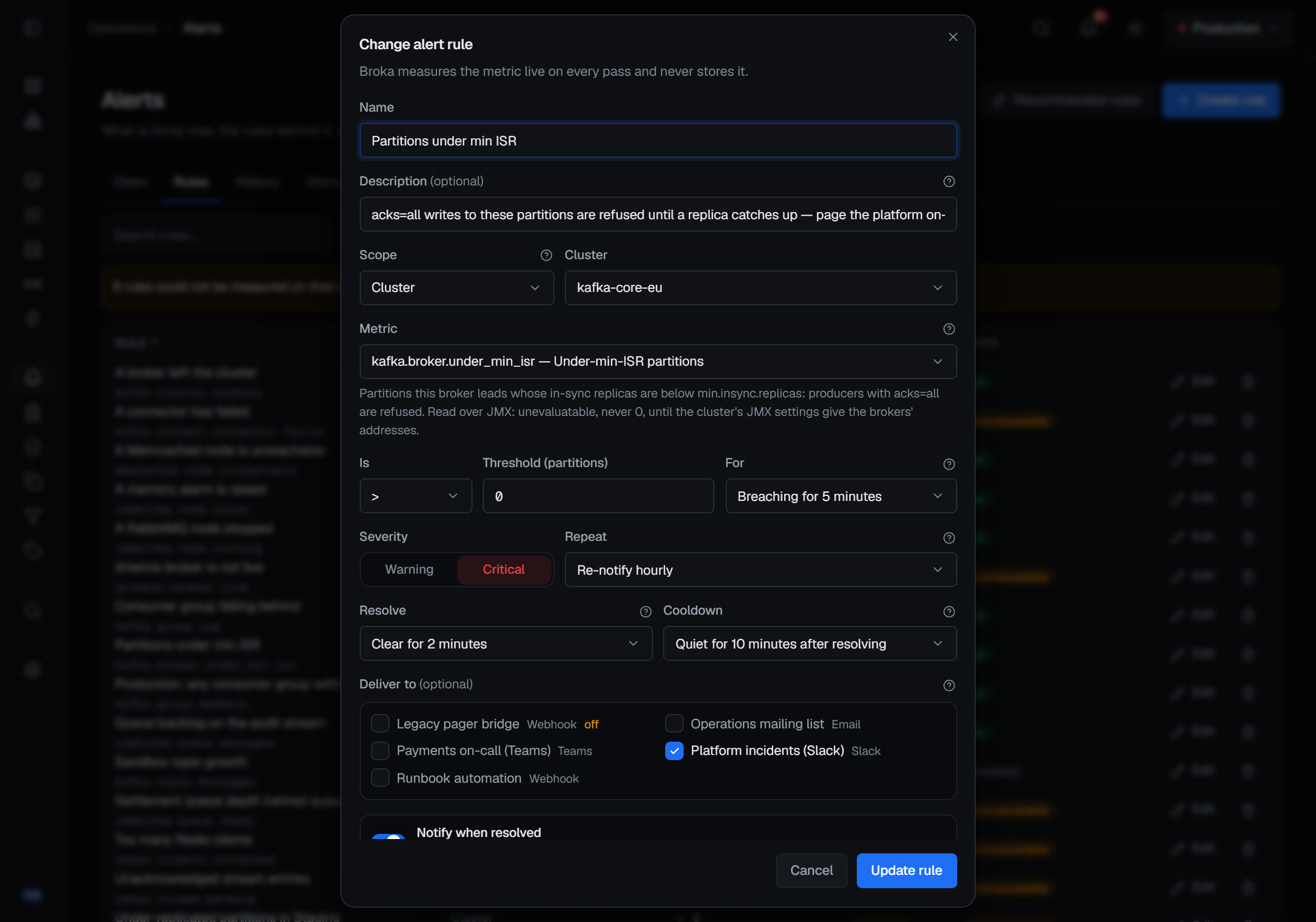
A rule can now watch a Kafka Connect cluster and its connectors, the Schema Registry, and every JMX figure worth acting on, with starter rules for each. A component that does not answer reads reachable = 0, which a rule can fire on.
Alerting also settles: an incident resolves once its figure has stayed clear for a while (two minutes unless you choose otherwise), an incident that reopens soon after does not notify again (ten minutes), and everything that breaches on one connection at once reaches a channel as one message.
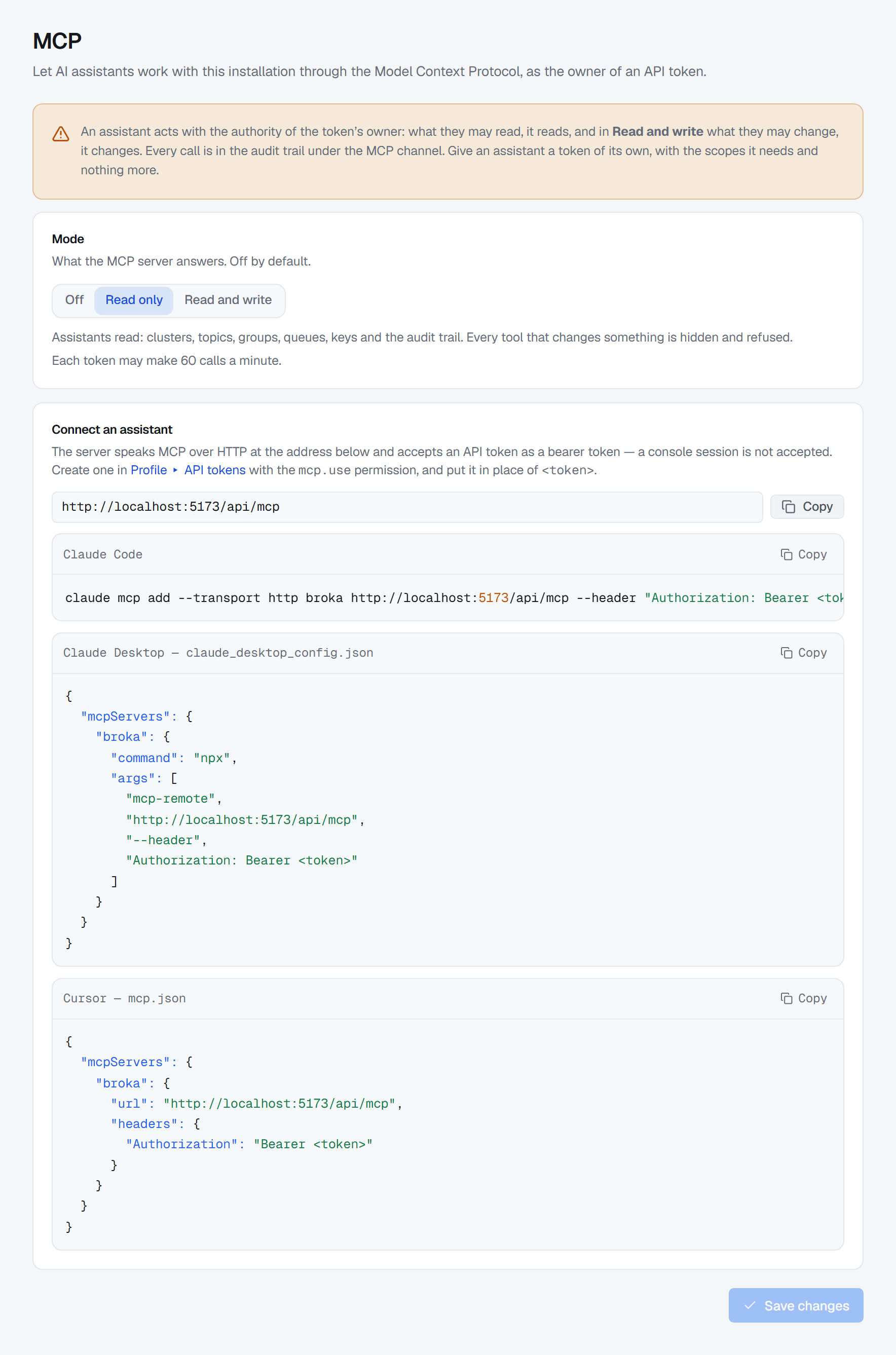
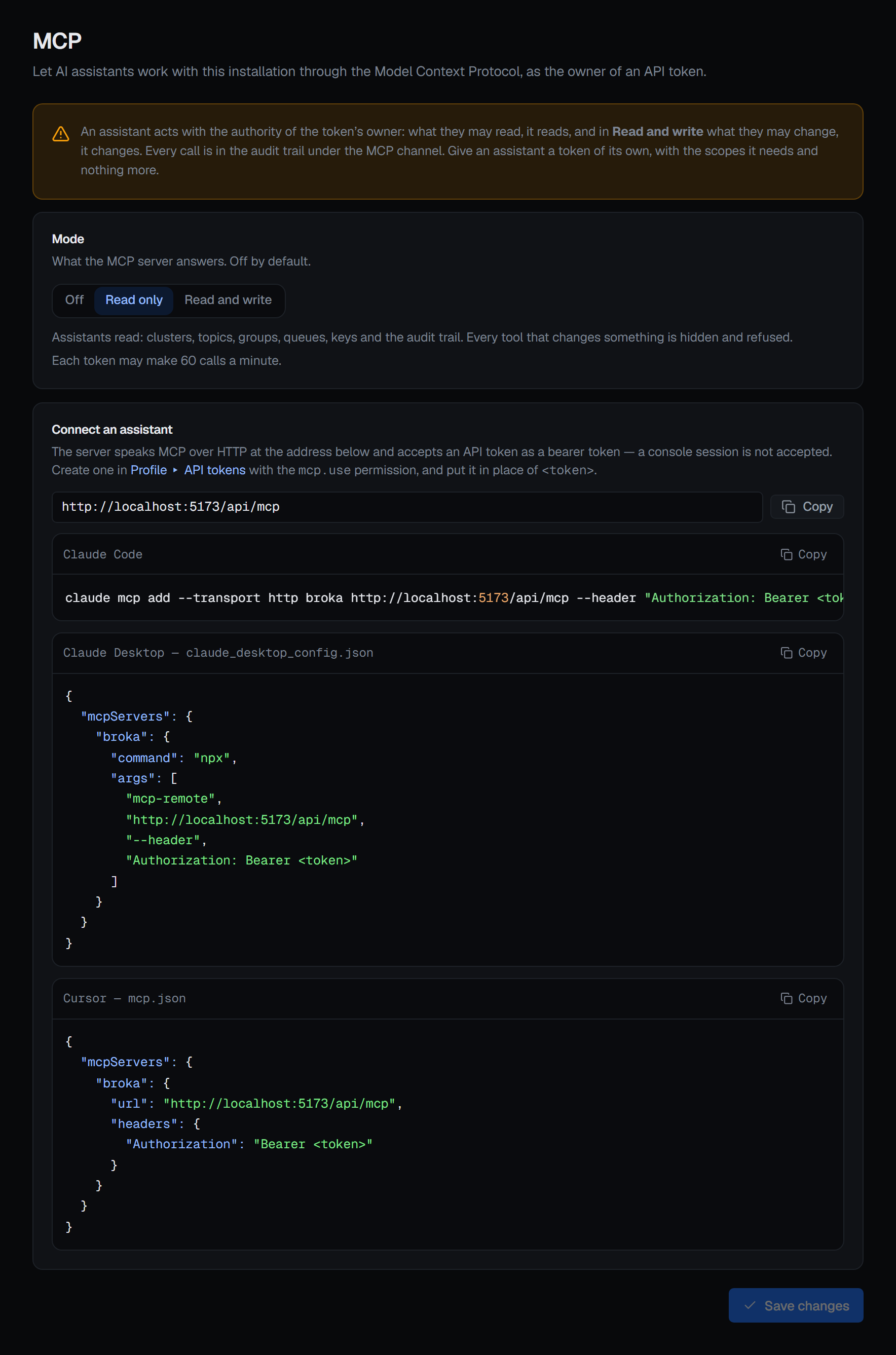
An MCP server for AI assistants (Commercial, 1.0.1)
Claude Code, Claude Desktop, Cursor or another MCP client reads the estate and, where an administrator allows it, changes it — as the owner of an API token, with that person's permissions, under every guard the console applies, and on the audit trail. It is Off until an administrator turns it on in Settings ▸ MCP, as Read only or Read and write.
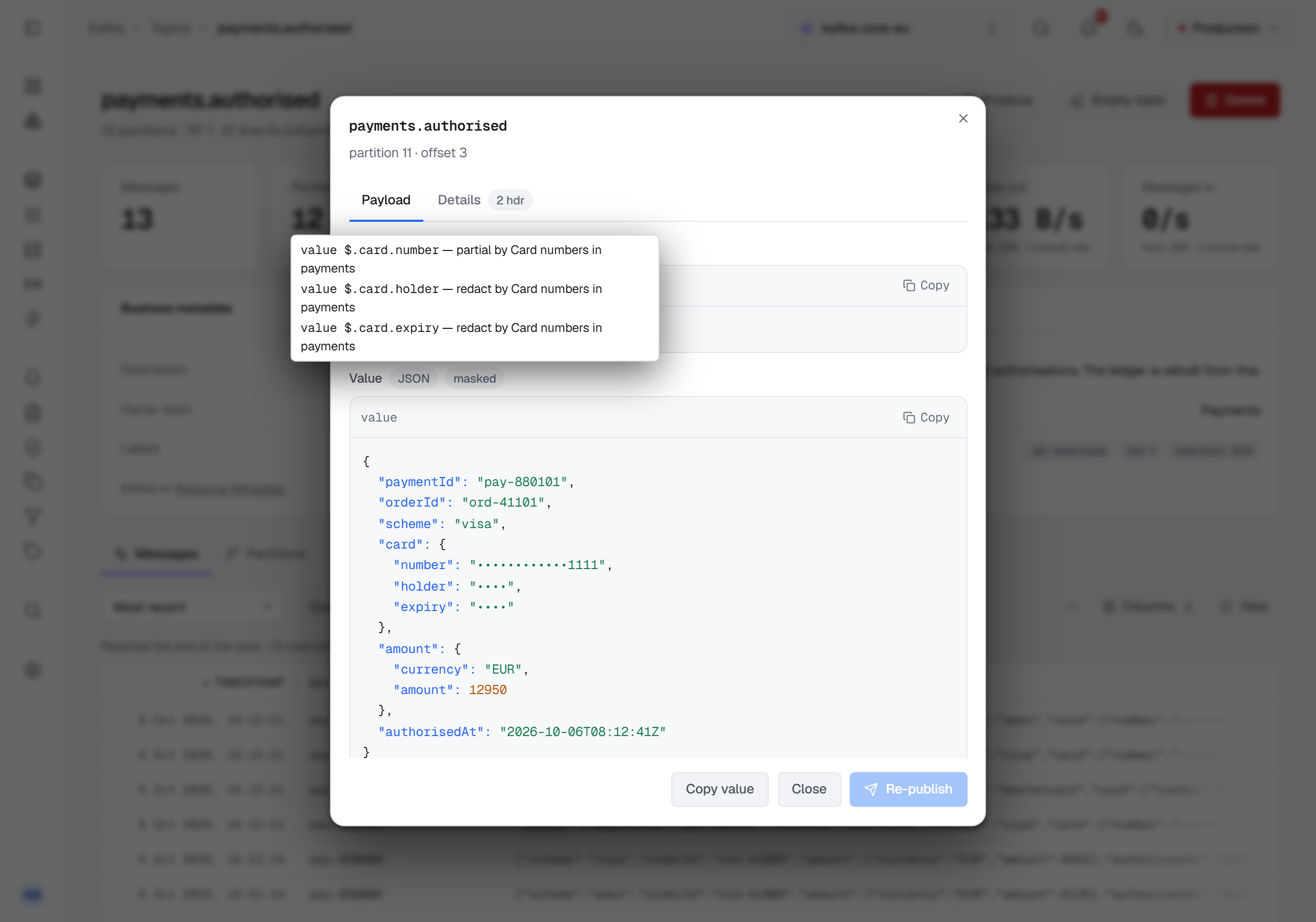
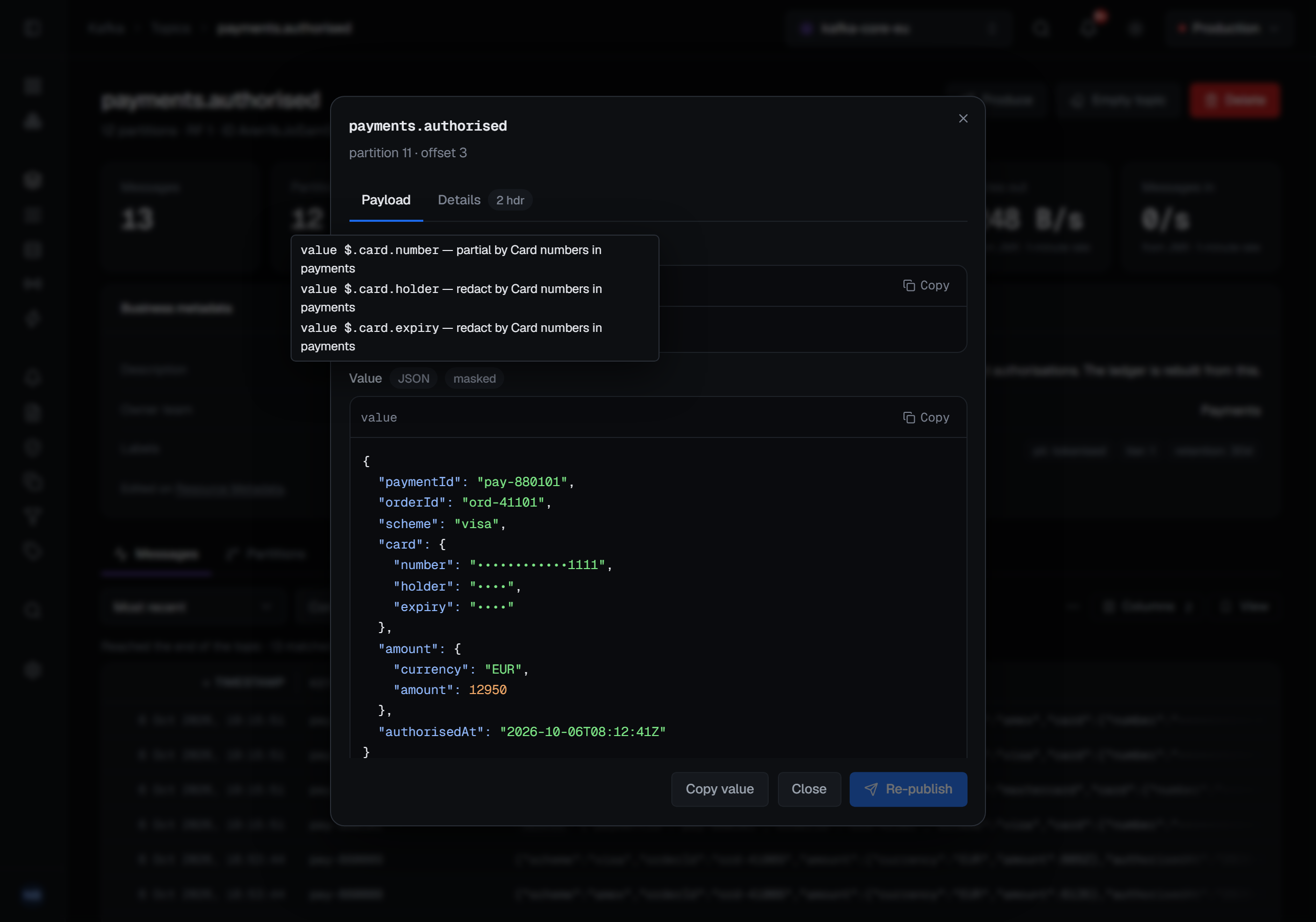
Data masking (Commercial, 1.0.1)
Rules hide chosen fields of messages and values — a card number, an address, a header — from people who may read the rest. Seeing them unmasked is a permission of its own, and every such read is recorded.
A release check, and safer accounts (1.1.0)
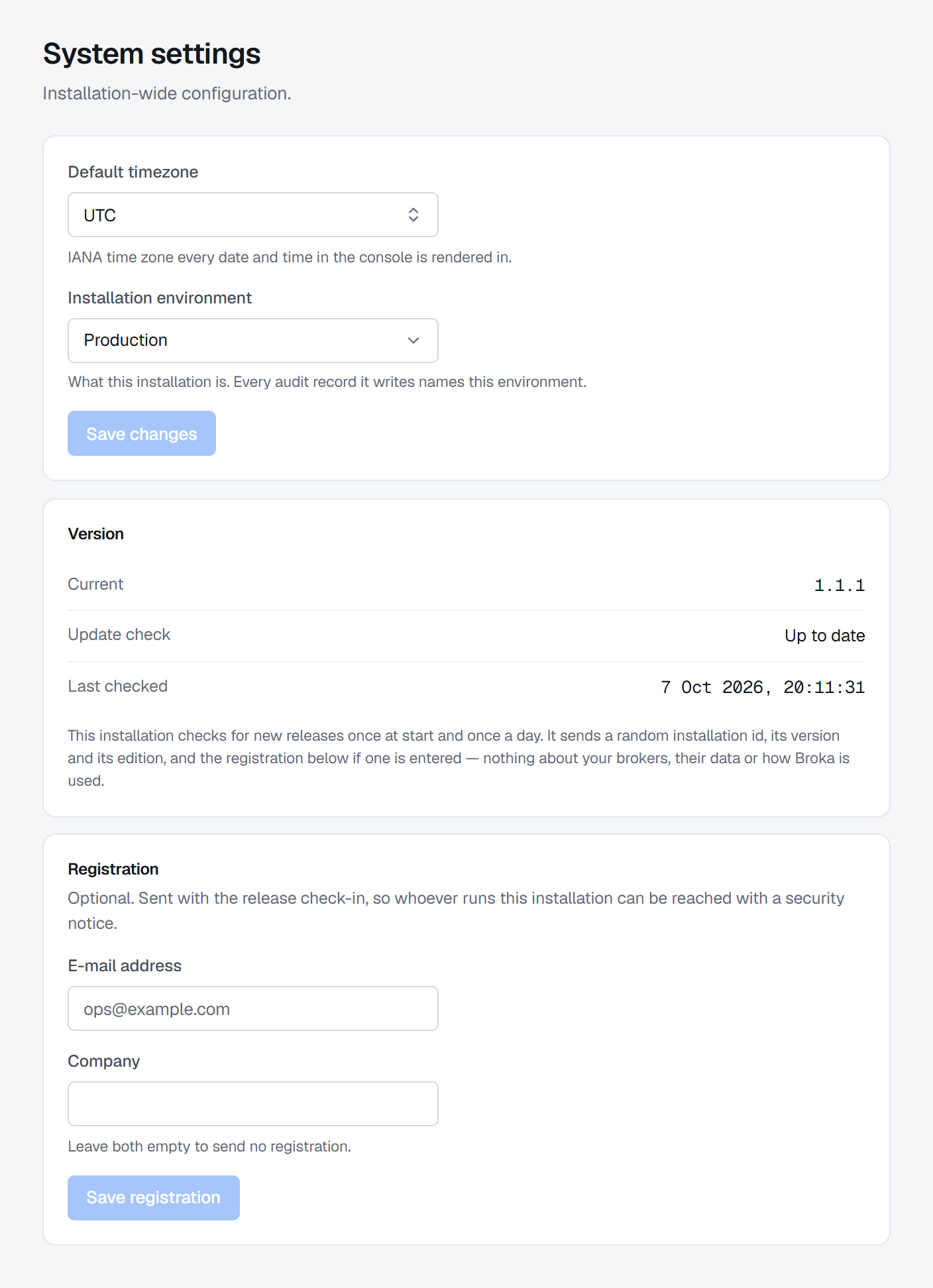
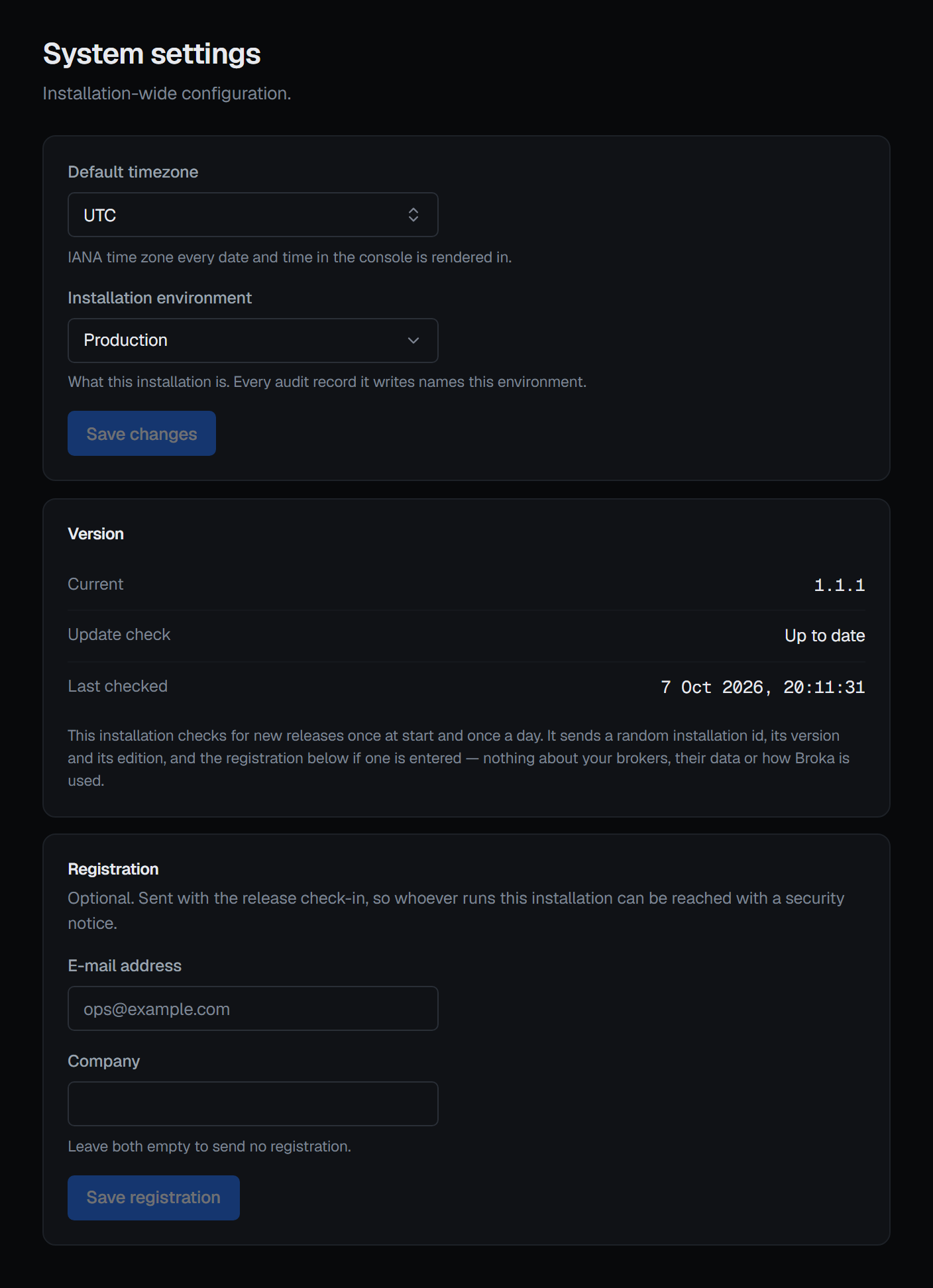
- A check for new releases. Settings ▸ System says when a newer release is out — Update available, Up to date or Not checked yet. Once at start and once a day, the installation sends its identifier, version and edition, and nothing about your brokers or how you use BROKA.
- Unused accounts are disabled. An account nobody has used for 90 days is disabled; the window is yours to change (30 to 365 days) or turn off, and the last account that can manage users is never disabled.
- Sign-in lockout. After 3 to 9 failed sign-ins (5 unless you change it), the account is locked for 5 to 1440 minutes (15 unless you change it).
- Access Review shows resource grants (Commercial): the access a resource-pattern grant gives, account by account and permission by permission.
Fixes (1.1.1 and 1.1.2)
1.1.1 made Kafka client-metric subscriptions a set of choices rather than typed names, and made them work on Kafka 3.7 to 3.9. It fixed a set of things that were wrong without saying so: a cleared Topics search that kept searching, a read from a time that silently started from the beginning, Redis times shown in the browser's time zone, a Copy button that said Copied when it could not copy, and a password reset that left a locked account locked. 1.1.2 fixed Access Review's By permission tab, which froze the browser before a permission was picked.
Upgrading
Set BROKA_VERSION in your .env to the new version, take the new compose.yml, pull and start; back up the database
and .env first. 1.1.0 applies database migrations when it starts, and they go forward only. The release notes list
what each version needs.
Where to read more
- Release notes — every change, known limitations and upgrade notes, per version. The Atom feed carries each release and each new guide as it is published.
- Download Community — the Compose recipe for the current release.