

Shovels and federation
Updated 1 October 2026 · applies to 1.0.0 · Commercial
The two ways this cluster exchanges messages with another one — and they are not variants of each other.
A shovel is a one-way link the broker runs for you: you name a source and a destination, and it moves messages between them. Federation is policy-driven: you register an upstream, and a policy naming it creates one link per matched object.
Put the other way: a shovel is something you define, and federation is something a rule creates.
The screen has a tab for each, both scoped by the Vhost selector in the header.
Shovels
Each shovel shows what it is moving — source to destination — its acknowledgement mode, its prefetch, and its state. no-ack is marked, because it is the fastest mode and the only lossy one: anything in flight when the link drops is gone. A shovel that sets no prefetch shows a dash, meaning the plugin's own default applies. Forwarded, the number of messages the shovel has moved, starts hidden; the tab's Columns control turns it on, and it shows a dash where the plugin reports no count.
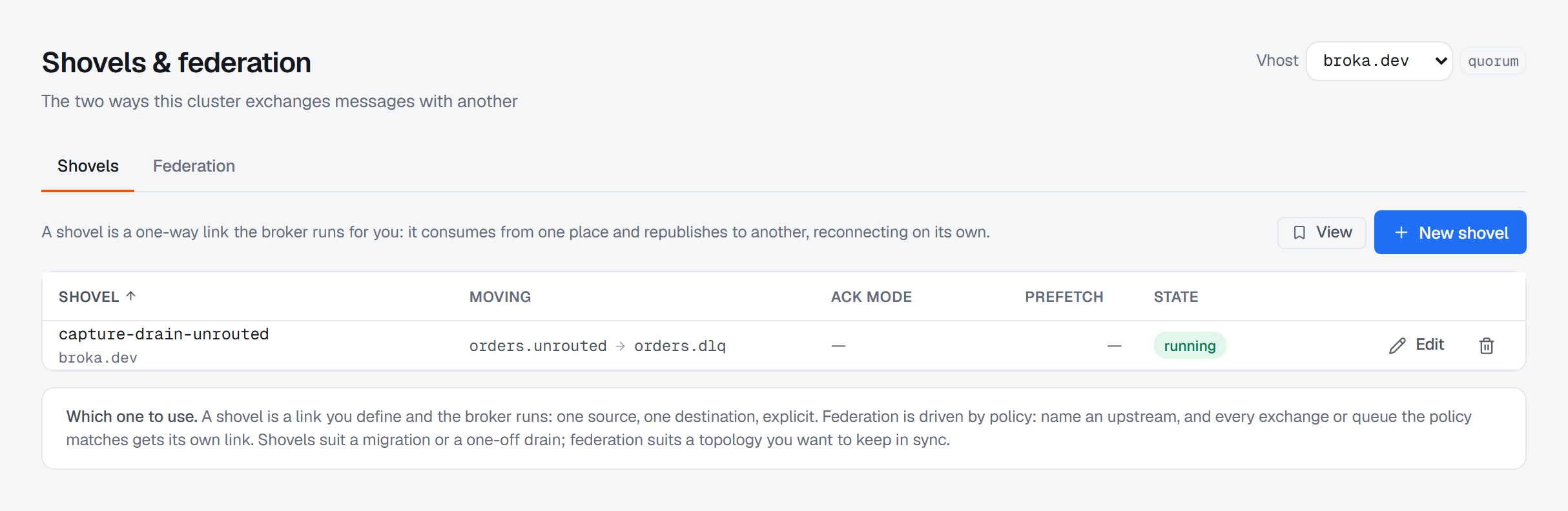
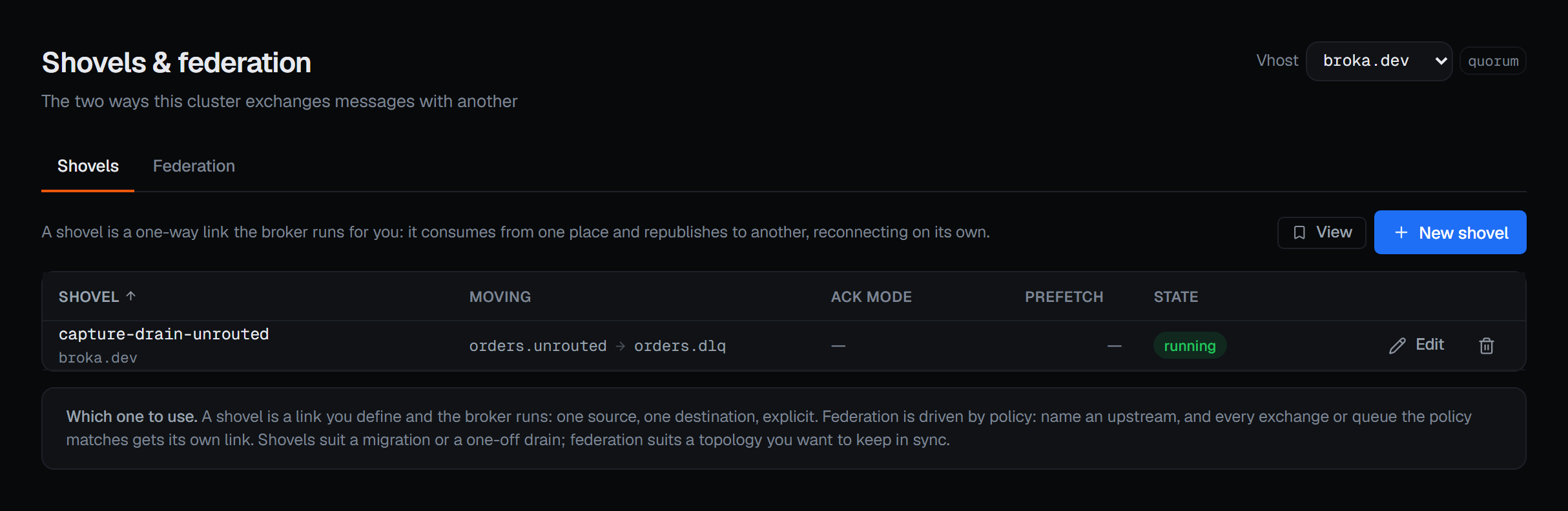
Three states are kept apart because they mean different things:
- Not reported — the shovel is defined, but the plugin is not reporting a state for it. That is not the same as stopped.
- Terminated — with the broker's own reason where it gave one.
- Running, blocked — running and currently held.
A shovel that has terminated can still say what it was moving, because BROKA reads the definition and the state separately and joins them. The plugin's state list carries no topology for a terminated shovel; the definition does.
Deleting the definition is what stops a shovel — there is no separate stop, and the confirmation says so rather than leaving you looking for one: messages already forwarded stay where they were delivered, and anything still in the source stops moving. The confirmation asks for a reason.
New shovel creates one in the selected virtual host, from a name, a source queue and a destination
queue, the acknowledgement mode, and optionally a prefetch count, a delete-after rule (never,
queue-length or a message count) and a reconnect delay. Leave a URI empty and it points at this broker.
A name already used in that virtual host is refused rather than replaced: the dialog says so, and Edit on
that shovel's row is the way to change it.
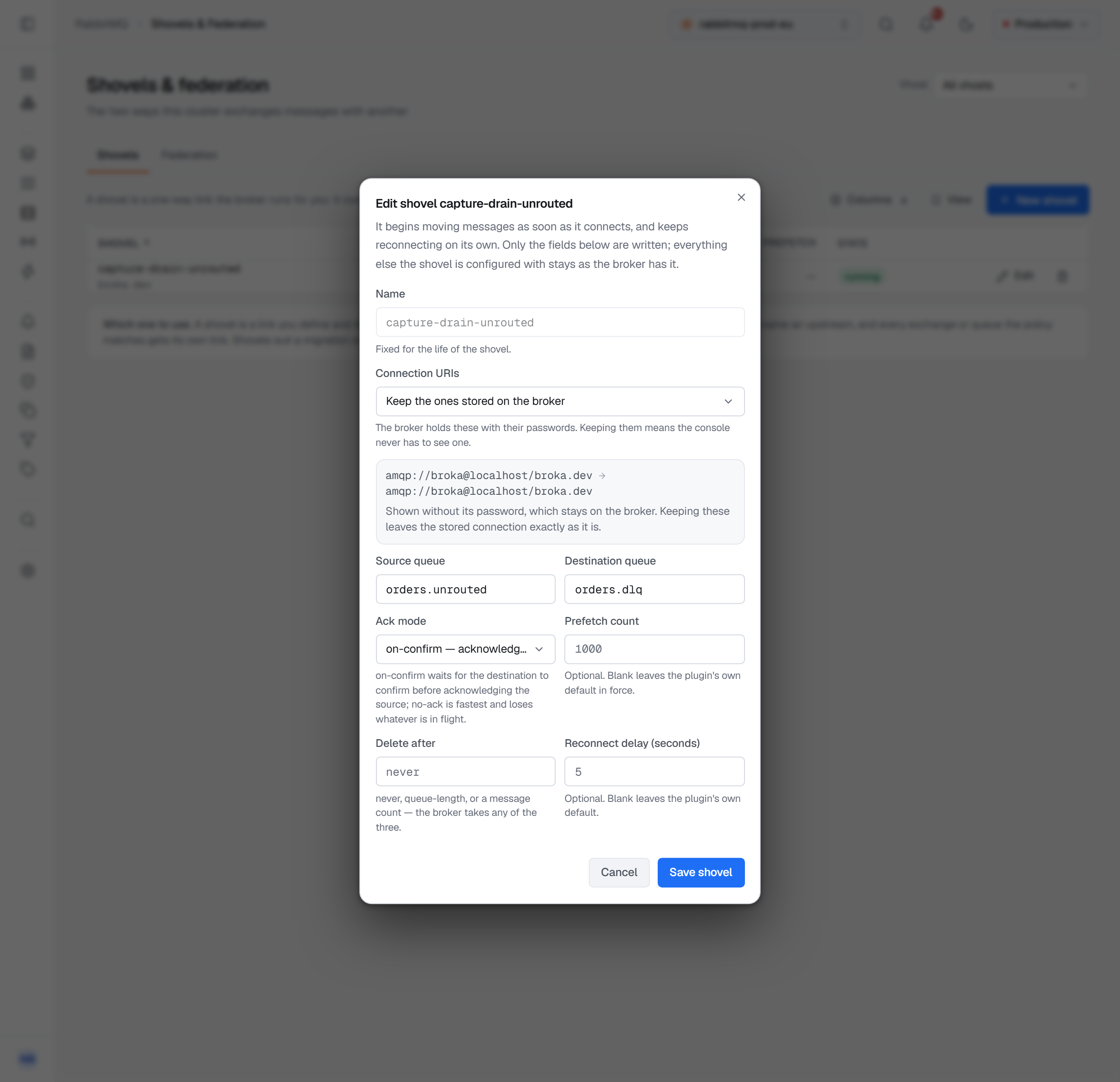
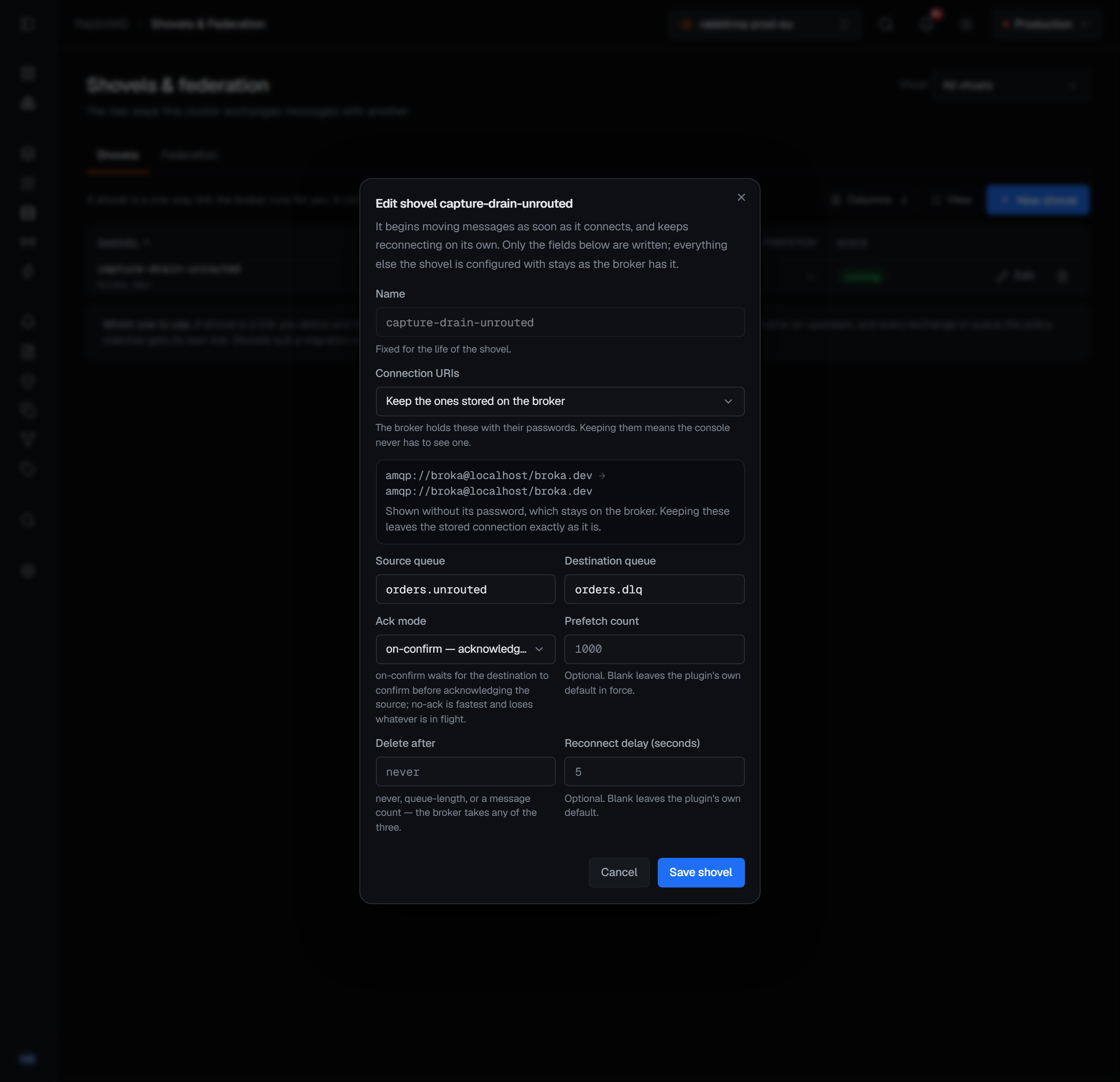
Edit opens the same form with the name locked, and names any keys the shovel carries that the form
does not model — those are kept as they are. Three kinds of shovel cannot be edited here, and their
Edit is locked with the reason: one configured in the broker's own file rather than at runtime (which
cannot be deleted from here either), one using AMQP 1.0, and one moving through an exchange rather
than a queue.
A shovel started by a queue's Move messages appears here too, but only while it runs: it removes itself once it has moved the messages the queue held when it started. Deleting it before then stops the move. See Message operations.
Federation
Upstreams and links are two tables, deliberately apart: what this cluster could pull from, and what is federating right now.
An upstream on its own moves nothing. It is a stored connection, and a policy naming it is what creates the links. An upstream no policy names is marked unused — and the tooltip says that is configuration, not a fault.
A link that stays in starting is one that cannot reach its upstream and is retrying. That is worth knowing because a 4.3 broker carries no error text on a federation link, so "starting" is the symptom you get instead of a message. Where a broker does report a failure for a link, a warning icon on its row carries the text.
New upstream registers one from a name and its remote URI, with the acknowledgement mode, the maximum hops, and optional prefetch, reconnect delay, expiry, message TTL and remote exchange or queue. A name already used in that virtual host is refused, as a shovel's is. Creating one moves nothing until a policy names it — see Policies. Deleting an upstream leaves any policy that names it matching, and the links it fed stop; the confirmation says so, and reminds you to delete the policy too if the federation is meant to go away. It asks for a reason too.
New shovel, New upstream, Edit and delete appear only for someone allowed to change this cluster, and not in a read-only environment or on a read-only connection.
Credentials never come back
An upstream's remote address is shown with its username and without its password.
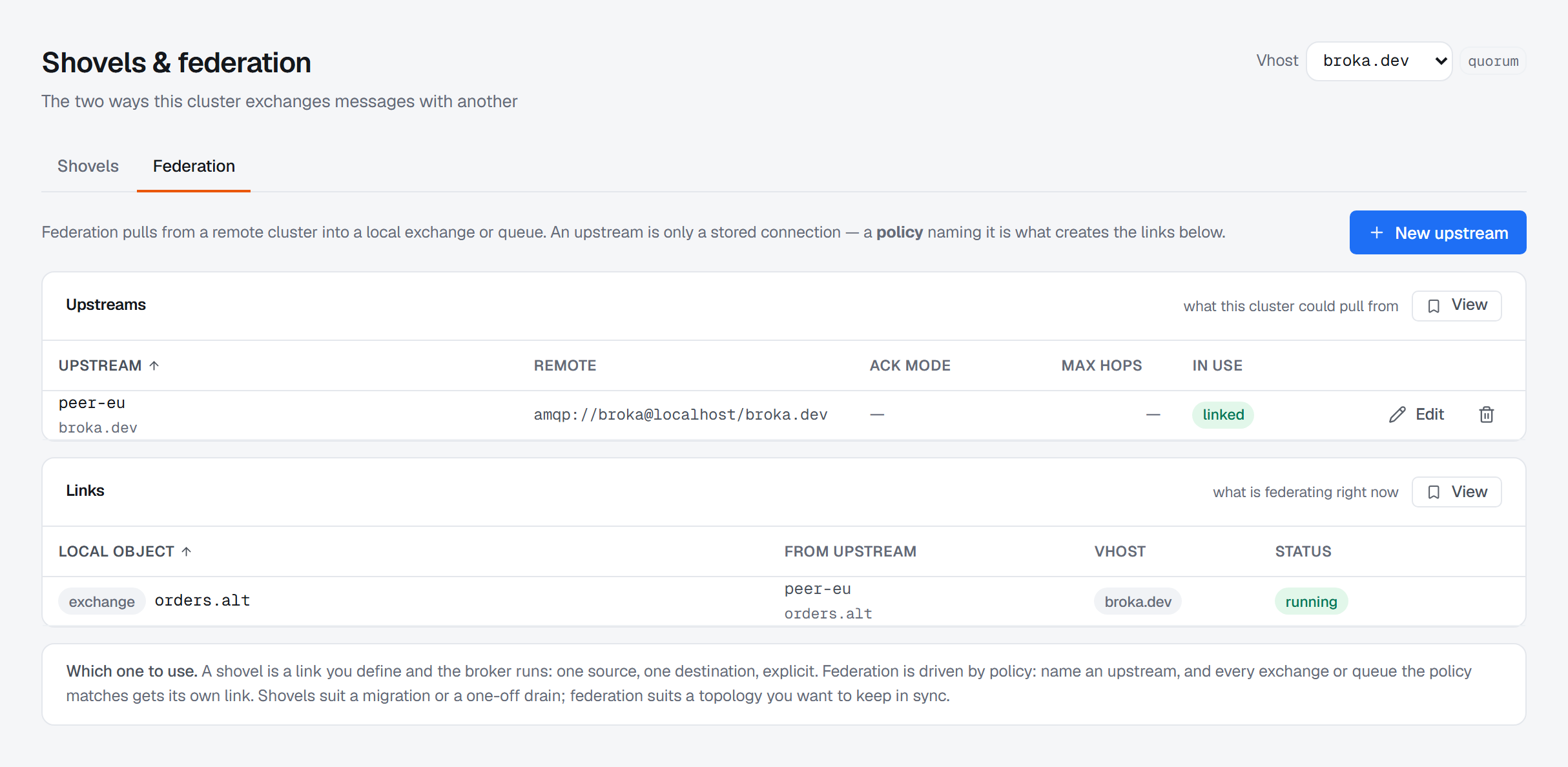
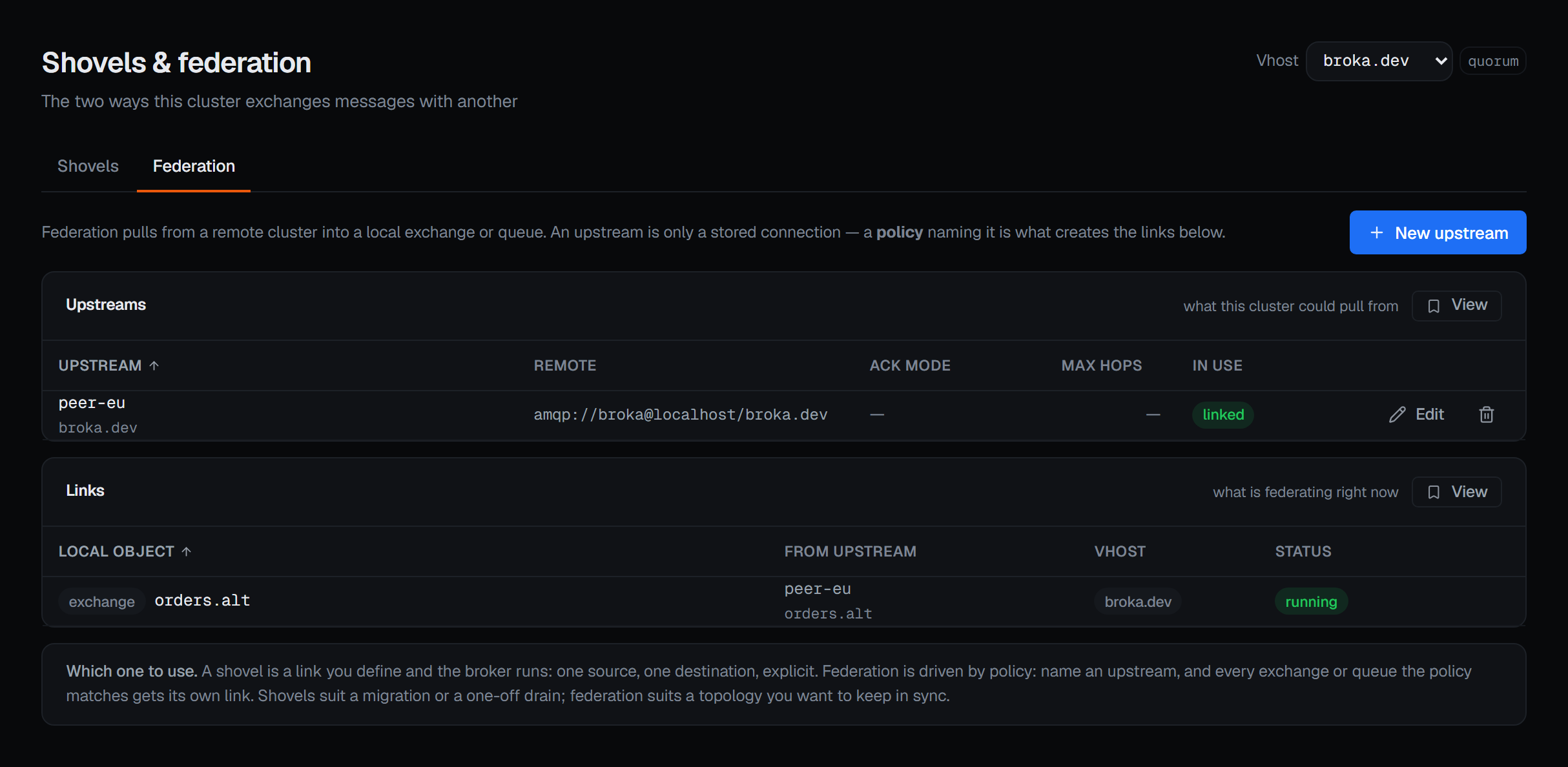
The password is not masked — it is removed, in the broker service, before the value reaches the orchestrator, its logs, the wire or a browser's network panel. Masking would leave something a later write could send back as if it were real.
Editing does not need it back. When you edit a shovel or an upstream, the form keeps the URI stored on the broker by default — shown without its password — and the broker service re-sends the one it already holds, so the password never crosses the wire in either direction. Choose to replace it instead, and the new URI is required in full, password included. The create form says the same thing up front: a password you type is stored by the broker and never shown here again.
An address BROKA cannot parse is reported as absent rather than passed through, on the same reasoning: an unparsed URI is one this code cannot promise it cleaned.
What is recorded
Creating, editing and deleting a shovel or an upstream is audited — and the entries are credential-free by construction: they record the source and destination objects, the acknowledgement mode and the hop limit, and never read the URI fields at all.