

Message operations
Updated 6 October 2026 · applies to 1.0.1 · Commercial
Four operations, and the differences between them are the whole page: publishing tells you what the broker did with the message and not what a consumer did, reading a queue takes messages away, reading a stream does not, and moving a queue's messages hands them to the broker to deliver elsewhere.
Publishing reports what the broker did — never delivered
A publish goes over AMQP with publisher confirms and the mandatory flag, so the broker answers it, and the answer is one of three:
| Answer | What the broker said |
|---|---|
| Confirmed | It took the message: at least one queue has it |
| Returned | Nothing routed it — no binding matched, and no alternate exchange took it. The broker's reply code and text are shown with it |
| Refused (nacked) | A queue it reached would not take it — one at its length limit that rejects publishes does this |
The first is a success and the other two are errors, because in both the message is not in any queue.
A confirm is still not a delivery, and BROKA will not present it as one: it is the broker taking responsibility for the message, not a consumer receiving it. An exchange's Publish dialog says so before you send.
Because the publish is made over AMQP, it needs the connection's AMQP endpoint to be reachable — the connection test warns when it is not. A missing exchange, an internal one or a virtual host the account may not enter is refused in the broker's own words.
Where you publish from decides what you are testing. Publishing to an exchange exercises your routing. Publishing from a queue's own page goes through the default exchange straight to that queue, which skips the exchange and the bindings your applications publish through — so it exercises the consumer instead. The console states which one you are doing on the dialog that does it.
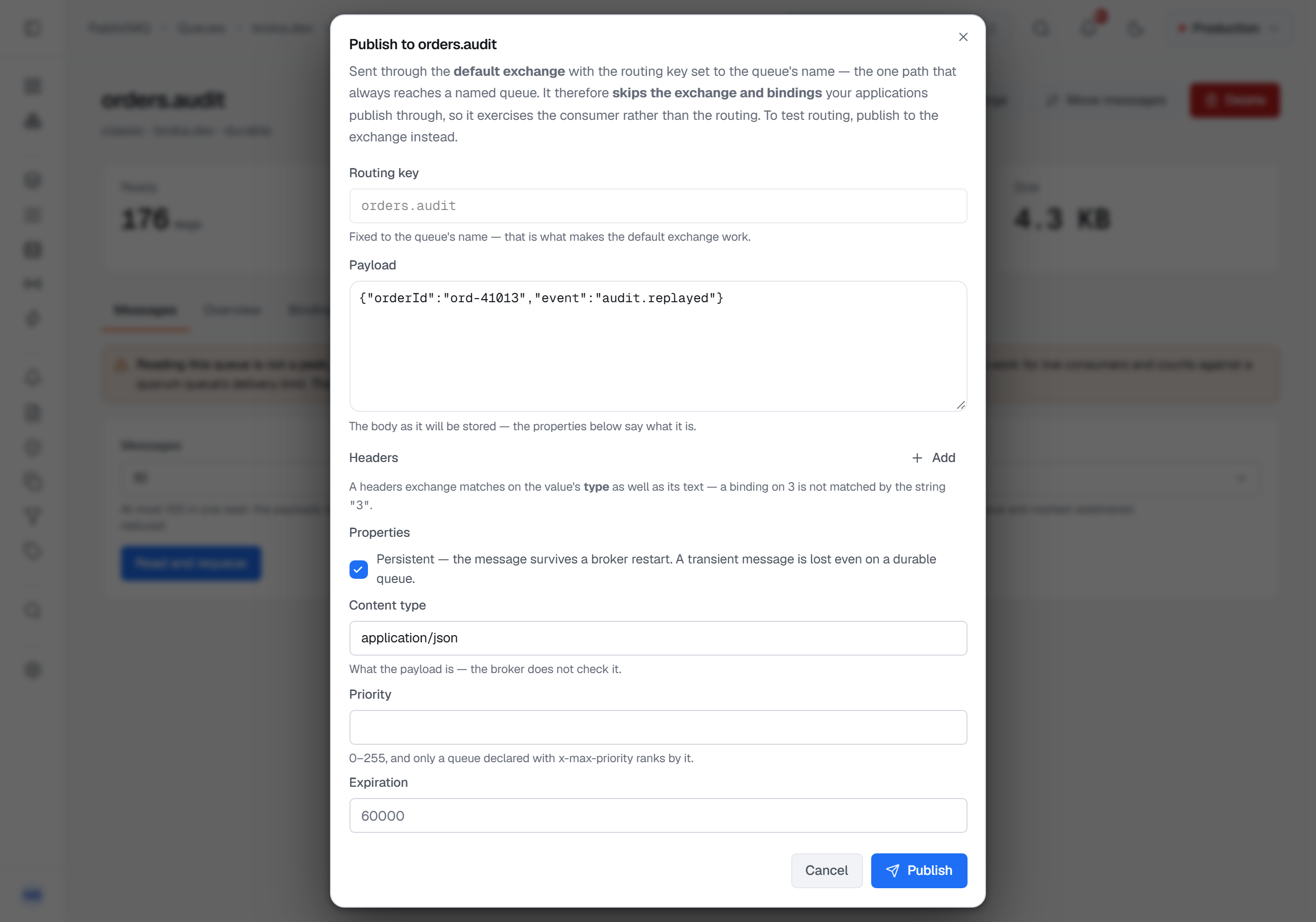
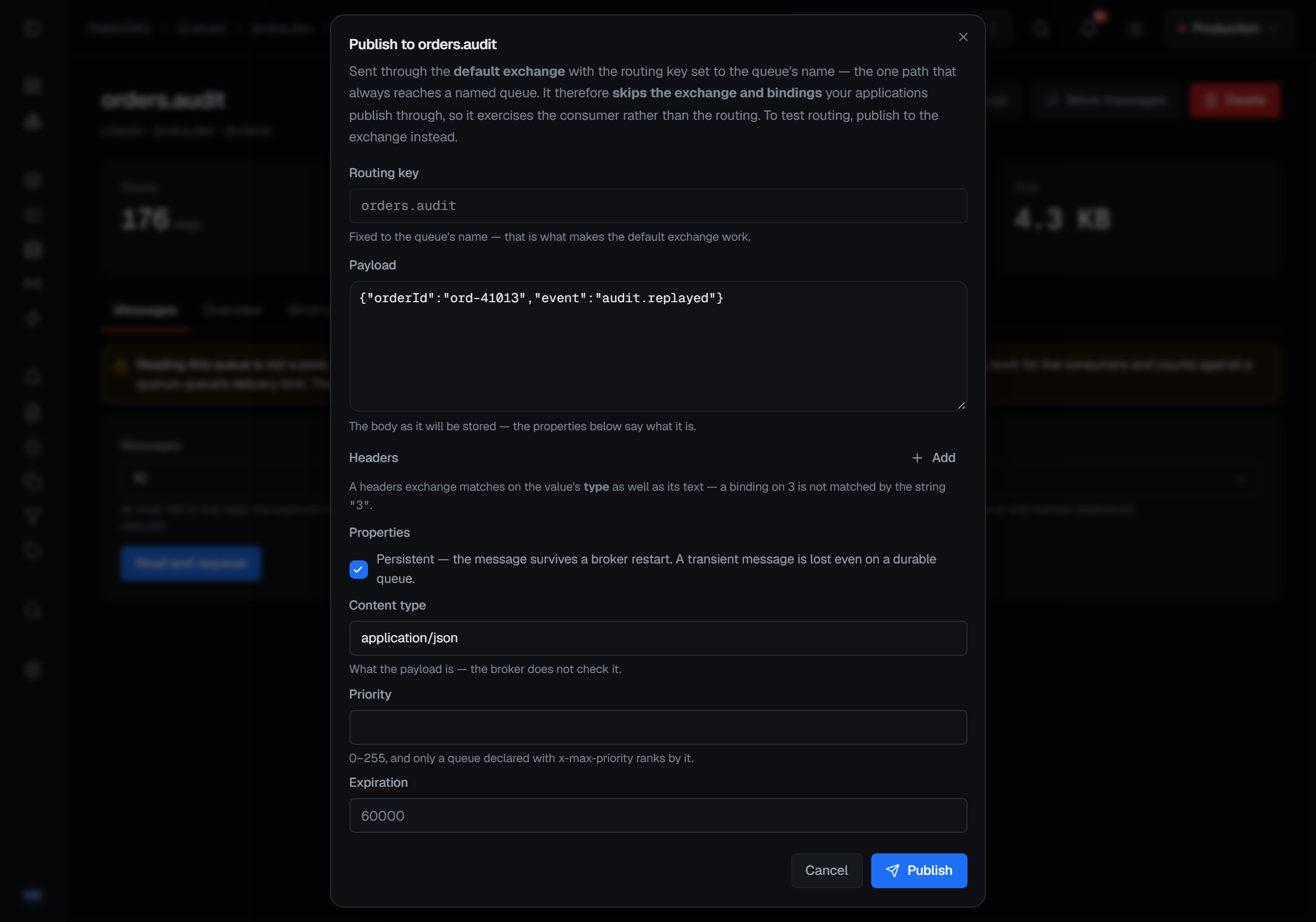
The routing-key field explains itself per exchange type: on the default exchange the routing key is a queue name; a fanout exchange ignores it entirely; a headers exchange matches on headers instead.
Reading a queue is not a peek
This is the sentence the screen leads with, above the controls rather than inside a dialog:
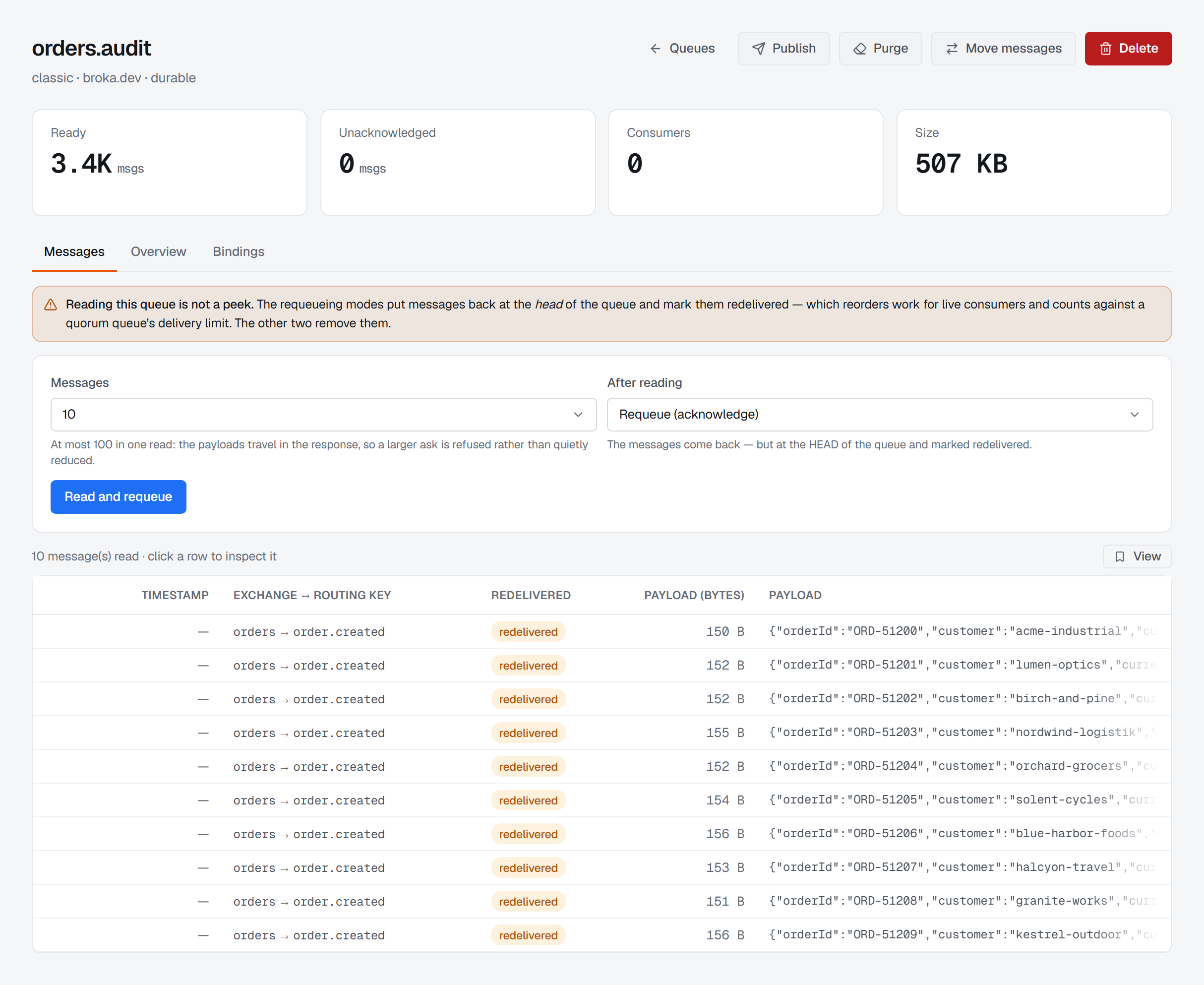
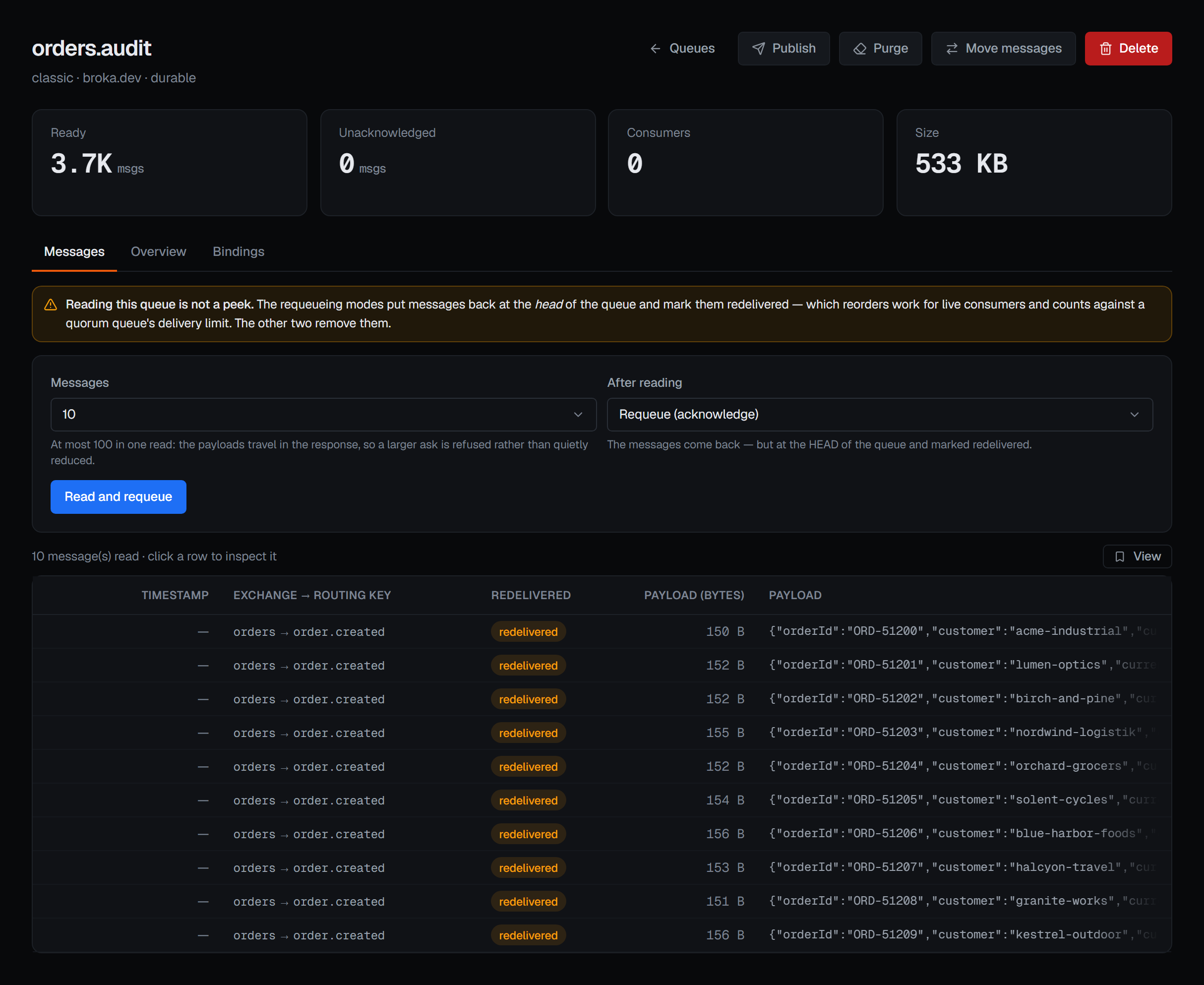
Reading this queue is not a peek. The requeueing modes put messages back at the head of the queue and mark them redelivered — which reorders work for live consumers and counts against a quorum queue's delivery limit. The other two remove them.
There are four modes, and all four touch the queue:
| Mode | What happens |
|---|---|
| Requeue (acknowledge) — the default | The messages come back, at the head of the queue, marked redelivered |
| Requeue (reject) | The same, through a negative acknowledgement |
| Remove (acknowledge) | The messages are gone for good |
| Dead-letter (reject) | Dead-lettered where a dead-letter exchange exists, dropped where it does not |
Choosing a destroying mode changes the screen: a second warning appears saying there is no undo, and the button itself relabels — Read and remove rather than Read and requeue, in a warning colour. The button says what it will do.
The redelivered flag follows the message. A requeueing read sets it for whoever eventually consumes it — so on the read that caused it the column is still empty, and on a second read of the same messages the flags appear. That is not a display lag; it is what the flag means.
Each row carries its timestamp, the exchange and routing key it arrived through, whether it was redelivered, its size and its payload — and opening one shows its full properties and headers.
Reading a queue, and reading a stream, take Read message contents (messages.read) as well as
viewing the connection; without it the panel says your role is not permitted to read messages. The
queue's depth, rates, bindings and consumers stay visible. Seeing the fields a data masking rule covers as they
are takes Read masked contents unmasked (messages.read.unmasked) too — on the queue's environment or
connection, or by a queue grant whose pattern matches it — and so does moving the messages of a queue a rule covers.
Reading a stream takes nothing away
A stream is an append-only log, and its banner says the opposite of the queue's:
Reading this stream takes nothing away. A stream is an append-only log: this read moves only its own position, and the messages stay exactly where they are for every other reader. Nothing is removed, requeued or marked redelivered.
That is a protocol difference rather than a policy: the management API's message-get is refused on a stream outright, so reading one means attaching as a consumer at an offset — and BROKA never acknowledges anything it reads.
Six ways to choose where to start, each with what it actually does:
- First — the oldest message still retained. Retention has already deleted anything older.
- Last — the final chunk, not the final message, so it usually returns several.
- Next — only what arrives from now on. On a stream nobody is publishing to it returns nothing, and that is not an error.
- Offset — an exact position. Past the end of the log it simply returns nothing.
- Timestamp — the first message at or after a moment, matched against the broker's own append time, so it works even on messages that carry no timestamp of their own.
- Relative time — a window back from now.
Every row carries the offset, which is the one thing the broker itself attaches.
A stream read is bounded by bytes as well as by messages: each body is cut to 256 KiB as it arrives, and the read stops once it has gathered 4 MiB, saying so and telling you where to start the next one. A stream of large messages therefore comes back in several reads rather than in one that runs out of room.
About stream timestamps
A stream message's timestamp is AMQP's optional publisher property — something the application sets, not something the broker stamps on arrival. A 4.3 broker sends no append time of its own over AMQP 0-9-1, so a message whose publisher set none has no timestamp to show, and the console says that rather than inventing one.
Order comes from the offset, which is always there.
Moving a queue's messages
Move messages, in a queue's header, hands the messages to the broker to deliver somewhere else, rather than reading them out through the console. It starts a one-shot shovel that moves the ready messages the queue holds when it starts to another queue or exchange — which must already exist, in any virtual host on the same broker — and removes itself once it has moved them. Each message is acknowledged on this queue only once the destination has confirmed it.
To an exchange with the routing key left blank, each message is republished under its own routing key, which is how a dead-letter queue is replayed — see Dead-letter flows. While the move runs, its shovel is listed under Shovels and federation, and deleting it there stops the move.
It asks for a reason, is recorded, and is not offered on a stream, which has no end to drain to. Where the shovel plugin is not enabled, the button is shown greyed out, with the reason.
Masked fields
A data masking rule can hide fields of the messages a queue or a stream holds
from people who may read the messages but not those fields. A rule names queues, or an exchange, which covers every
queue bound from it as the bindings stand when you read. A queue read and a stream read both come back masked from
the broker service: inside a JSON body a masked string reads ••••, a number 0 and a boolean false; a masked
header or message property — correlation_id, say — reads ••••; a body that is not JSON, or is binary, under a
rule that looks inside it is masked whole. A masked badge beside the payload, in the row and in the message's
detail, names on hover each masked field, its method and the rule — or, for a body masked whole, the reason.
Masking changes what you see, not what the read does: a requeueing read requeues the message as it is, and a removing read removes it.
Move messages is refused on a queue a rule masks for you — the messages would be readable wherever they landed — and the refusal names the rule. Publishing a new message is not affected.
Someone allowed to read the queue unmasked sees its messages as they are, with a shown unmasked badge, and each such read is recorded in the audit trail.